

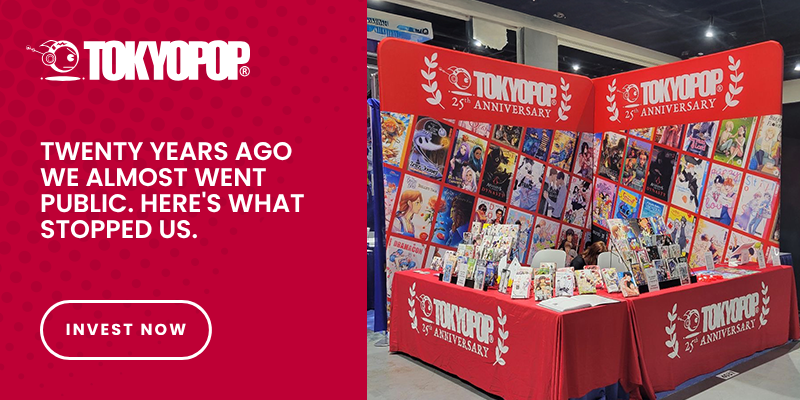
Tokyopop Wraps Reg CF Campaign: Nostalgia and “Kizuna” Framing Mask Non-Voting Equity Realities
Humberto SaabedraLOS ANGELES — Tokyopop founder and CEO Stu Levy has issued a lengthy direct-to-investor retrospective as the pioneer manga publisher concludes its Regulation Crowdfunding (Reg CF) offering on StartEngine. Pitching the campaign as a historical milestone that expanded Tokyopop’s shareholder base from 14 to over 300 “fan-owners,” the dispatch weaves personal narratives—from early-2000s expansion to the 2011 Tohoku earthquake—around a critical underlying admission: 2025 was a self-inflicted “rough year financially,” and institutional capital was not on the table.
- Primary Source:
[Tokyopop Reg CF Investor Letter / StartEngine Direct Portal Disclosure] - Disclosed Mechanics:
Expansion of micro-equity base from 14 legacy holders to 300+ Reg CF retail participants following an acknowledged financial contraction in 2025. - Capital Signal:
Pivot to retail crowdfunding reflects a lack of institutional venture/PE appetite or IPO viability for mid-tier publishing assets following revenue pullbacks.
OVERSCAN DESK NOTE: REG CF “OWNERSHIP” VS. TRUE EQUITY RIGHTS
Classification: Corporate Finance / Retail Equity Disclosures Cross-Reference: Tokyopop, StartEngine, Reg CF, SBI Group
| STRUCTURAL FEATURE | REG CF RETAIL PARTICIPATION | INSTITUTIONAL / PREFERRED EQUITY |
|---|---|---|
| Governance & Voting | Non-voting common or proxy-delegated stock; zero board seats or veto power. | Direct voting shares, board seats, protective covenants, and audit rights. |
| Liquidity & Exit | Indefinitely illiquid; no secondary trading market or defined redemption rights. | Defined liquidity windows, registration rights, and M&A dragging privileges. |
| Liquidation Waterfall | Bottom tier; wiped out first in corporate debt restructuring or asset sale. | Liquidation preferences ensuring capital return prior to common distribution. |
| Information Rights | Standardized annual SEC Form C-AR filings; no real-time audit access. | Quarterly audited financial statements, real-time metrics, and balance-sheet visibility. |
1. Capital of Last Resort vs. Narrative Framing
Regulated Crowdfunding allows mature assets facing financial headwinds to tap unaccredited retail fans for capital without granting corporate governance or financial covenants. The transition from 14 consolidated owners (including long-standing venture backer SBI) to 300+ micro-investors is framed as “momentum” and Kizuna (solidarity). In corporate finance, however, expanding to hundreds of retail shareholders introduces administrative friction while bringing zero institutional leverage or strategic distribution access.
2. The Conflation of Fan Loyalty and Legal Ownership
The campaign pitch repeatedly conflates brand participation with genuine corporate equity. Reg CF investors acquire micro-stakes in non-voting equity that sit at the bottom of the liquidation waterfall. If Tokyopop turns around, retail holders have no secondary market to realize gains; if the publisher contracts further, retail equity absorbs the downside first behind secured creditors and legacy preferred shareholders.
3. The Post-Boom Media Publishing Bottleneck
Tokyopop’s pivot to Reg CF highlights the broader valuation reset across mid-tier Western manga and graphic novel publishers following the pandemic sales boom. Lacking scale, proprietary global IP ecosystems, or tech-infrastructure multiples, traditional print aggregators are increasingly priced out of institutional equity markets, leaving retail crowdfunding as a primary non-dilutive relief valve for legacy founders.
4. The Licensed IP Illusion: Rented Brands vs. Core Equity
Capital allocators must scrutinize Tokyopop’s heavy marketing emphasis on high-profile brand licenses. Prominently cited partnerships often reflect short-term, non-exclusive, or one-off product lines rather than permanent IP ownership. Historically, these licensed SKUs floundered in an oversaturated physical retail environment due to misjudged print runs, weak promotional execution, and executive mismanagement. Investors are funding a publisher burdened by minimum royalty guarantees and inventory liability on rented properties, rather than an owner-operator of durable, high-margin proprietary assets.
5. Institutional Write-Off Directive: Reallocating to Mid-List Value
If institutional venture capital, private equity, or commercial lenders were ever to underwrite Tokyopop, that transaction window closed two decades ago during the mid-2000s North American manga boom. At that junction, an institutional entry could have enforced strict governance overhauls and executive management replacement. In 2026, after founder-led executive management has repeatedly pushed the enterprise to the brink of insolvency through flawed operational pivots, the asset is structurally unbankable. Institutional capital desks should write off Tokyopop completely, redirecting investment capacity toward disciplined mid-list publishers, independent localization houses, and unencumbered specialty catalogs with clean cap tables and modern operational governance.


