

Twin Engine Acquires Equity in Yoake, Enters Live-Action Production and Distribution
Humberto SaabedraTwin Engine Acquires Yoake Equity, Enters Live-Action Production and Distribution Stack
TOKYO — Japanese anime planning and production group Twin Engine Inc. has executed a capital and business alliance with film production and marketing firm Yoake Co., Ltd., bringing Yoake directly into the Twin Engine Group. The acquisition marks Twin Engine’s formal expansion into live-action film production, marketing, and distribution. The alliance’s initial project sees Twin Engine join the production committee and co-distribute Shino Tani ’95 (Death Valley ’95), a 2027 theatrical film directed by and starring Masaki Suda. The corporate integration follows Twin Engine’s August 2026 launch of its proprietary web manga imprint, “Bibibi Comic”, establishing an end-to-end IP lifecycle pipeline spanning print, animation, and live-action adaptation.
- Primary Source:
[Twin Engine Official Corporate Announcement / News ID: 20501] - Disclosed Mechanics:
Capital and business alliance integrating Yoake into Twin Engine Group; co-distribution rights for live-action theatrical slate starting with Shino Tani '95 (2027) - Supply-Chain Signal:
Anime production groups consolidating live-action production and distribution capabilities to mitigate long animation lead times and capture multi-format IP monetization margins in-house
OVERSCAN DESK NOTE: ANIME HOUSES AND LIVE-ACTION PORTFOLIO DIVERSIFICATION
Classification: Media Production / M&A & IP Strategy Cross-Reference: Twin Engine, Studio Colorido, Yoake Co., Bibibi Comic
┌────────────────────────────────────────────────────────────────────────┐
│             TWIN ENGINE FULL-STACK IP PIPELINE ARCHITECTURE            │
├────────────────────────────────────────────────────────────────────────┤
│ PHASE 1: ORIGINATION & UPSTREAM IP CONTROL                             │
│ • "Bibibi Comic" web manga label (In-house IP creation)                │
│                                │                                       │
│                                ▼                                       │
│ PHASE 2: DUAL-FORMAT PRODUCTION DECISION ENGINE                        │
│ ┌──────────────────────────────┴──────────────────────────────┐        │
│ │ ANIMATION ENGINE (Core Hub)  │ LIVE-ACTION ENGINE (Yoake)   │        │
│ │ • Studio Colorido, Geno,     │ • Mid-budget feature films   │        │
│ │   Twin Engine Digital        │ • Live-action adaptations    │        │
│ └──────────────────────────────┬──────────────────────────────┘        │
│                                │                                       │
│                                ▼                                       │
│ PHASE 3: DOWNSTREAM DISTRIBUTION & MARGIN RECOVERY                     │
│ • Direct co-distribution (Bypassing external studio distribution fees)│
└────────────────────────────────────────────────────────────────────────┘
1. De-risking the Animation Bottleneck
Pure-play anime production hubs face systemic schedule bloat, talent shortages, and 3-to-4-year lead times before a project generates theatrical or licensing returns. Integrating a proven live-action outfit like Yoake allows Twin Engine to run faster, lower-budget film production cycles, smoothing out cash flow between major anime cycles.
2. Internalizing IP Adaptation Margins
By pairing Yoake with its newly launched “Bibibi Comic” web manga imprint, Twin Engine closes the loop on IP adaptation. Instead of licensing out popular webtoon/manga properties to external film studios and accepting minority royalty splits, Twin Engine retains production committee equity and distribution fees across both animated and live-action formats.
3. The Mid-Tier Distribution Moat
Rather than remaining a vendor or sub-contracted animation production desk, Twin Engine continues to evolve into a full-service media conglomerate. Co-distributing theatrical releases alongside established film marketers prevents margin leakage to traditional legacy distributors like Toho or Shochiku on smaller and mid-budget projects.
2026-09-08T16:15:00Z | INDUSTRY STRUCTURE | TWIN ENGINE / BANDAI NAMCO CAPACITY DYNAMICS
Beyond the Contractor Trap: Bandai Namco Capacity Overflow vs. Twin Engine Autonomy
Market assumptions that Bandai Namco’s investment in Twin Engine signaled a shift toward exclusive subcontracting misread the fundamental bottleneck in modern anime production: extreme line saturation at legacy flagship studios.
Bandai Namco Filmworks (Sunrise, Actas, Bandai Namco Pictures) has faced unprecedented slate paralysis across major franchises like Mobile Suit Gundam and Love Live!. Partnering with Twin Engine was an operational relief valve to secure high-caliber production management and directorial talent without inflating Bandai’s fixed payroll or balance sheet liabilities.
OVERSCAN DESK NOTE: THE CAPTIVE STUDIO VS. INDEPENDENT STACK MODEL
┌────────────────────────────────────────────────────────────────────────┐
│            VENDOR TYPES IN THE JAPANESE ANIMATION SUPPLY CHAIN         │
├────────────────────────────────────────────────────────────────────────┤
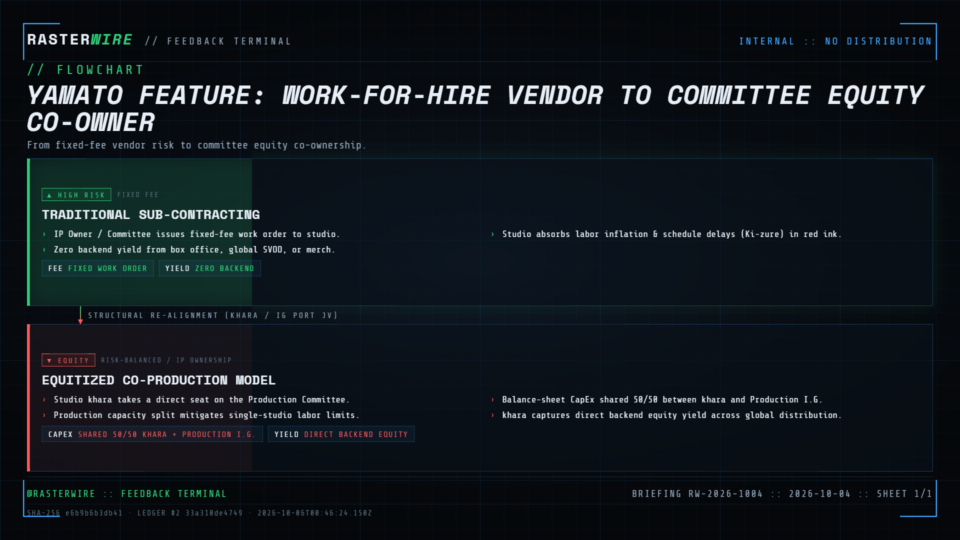
│ TYPE A: CAPTIVE SUBCONTRACTOR (The "Shitauke" Trap)                    │
│ • Dependent on 1-2 major publishers/studios for line allocation.      │
│ • Zero downstream IP equity or distribution yield.                     │
│ • Vulnerable to publisher budget cuts and schedule freezes.            │
├────────────────────────────────────────────────────────────────────────┤
│ TYPE B: HYBRID AGGREGATOR (The Twin Engine Model)                      │
│ • Baseline Revenue: Absorbs outsourced Tier-1 IP (Bandai Namco).       │
│ • Upstream Control: Owns manga/webtoon origination (Bibibi Comic).      │
│ • Cross-Media Hedging: Controls live-action execution/distro (Yoake).   │
└────────────────────────────────────────────────────────────────────────┘
1. Capacity Arbitrage Over Equity Control
Major IP owners (Bandai Namco, Kadokawa, Aniplex) are severely bottlenecked at the production line level. When Bandai allocated capital to Twin Engine, it bought guaranteed studio queue access, not exclusive corporate governance. For Twin Engine, taking Bandai’s outsourced work provides steady cash flow while maintaining full operational autonomy across its child studios (Studio Colorido, Geno Studio).
2. CEO Koji Yamamoto’s Anti-Subcontractor Blueprint
Since founding Twin Engine after heading Fuji TV’s Noitamina block, Koji Yamamoto’s explicit strategy has been avoiding the captive vendor trap. Accepting external production contracts without giving up IP rights on internal projects ensures Twin Engine remains an independent media group rather than a subsidiary talent pool.
3. The Yoake Deal Confirms Independence
A captive subcontractor does not launch proprietary webtoon labels or acquire film production and marketing firms to co-distribute live-action features like Shino Tani ’95. The Yoake acquisition proves Twin Engine is aggressively pursuing a full-stack media conglomerate model, using corporate partners like Bandai for capital and slate volume while building out an independent distribution and IP lifecycle framework.