
Deconstructing khara’s Equity Position in the New Space Battleship Yamato Feature
Humberto SaabedraRASTERWIRE TRADE DISPATCH // SPECIAL IP & PRODUCTION FORENSICS
DATE: October 6, 2026
SUBJECT: Joint Committee Equity & Co-Production: Deconstructing khara’s Equity Position in the New Space Battleship Yamato root2199 Feature
ENTITIES: Studio khara (Hideaki Anno), Production I.G / IG Port (TYO: 3791), Bandai Namco Filmworks, Voyager Holdings
CLASSIFICATION: B2B Trade Intelligence // Corporate Finance, Production Committee Equity & Capacity Risk
+-------------------------------------------------------------------------+
| RASTERWIRE // FEEDBACK TERMINAL               INTERNAL :: NO DISTRIBUTION |
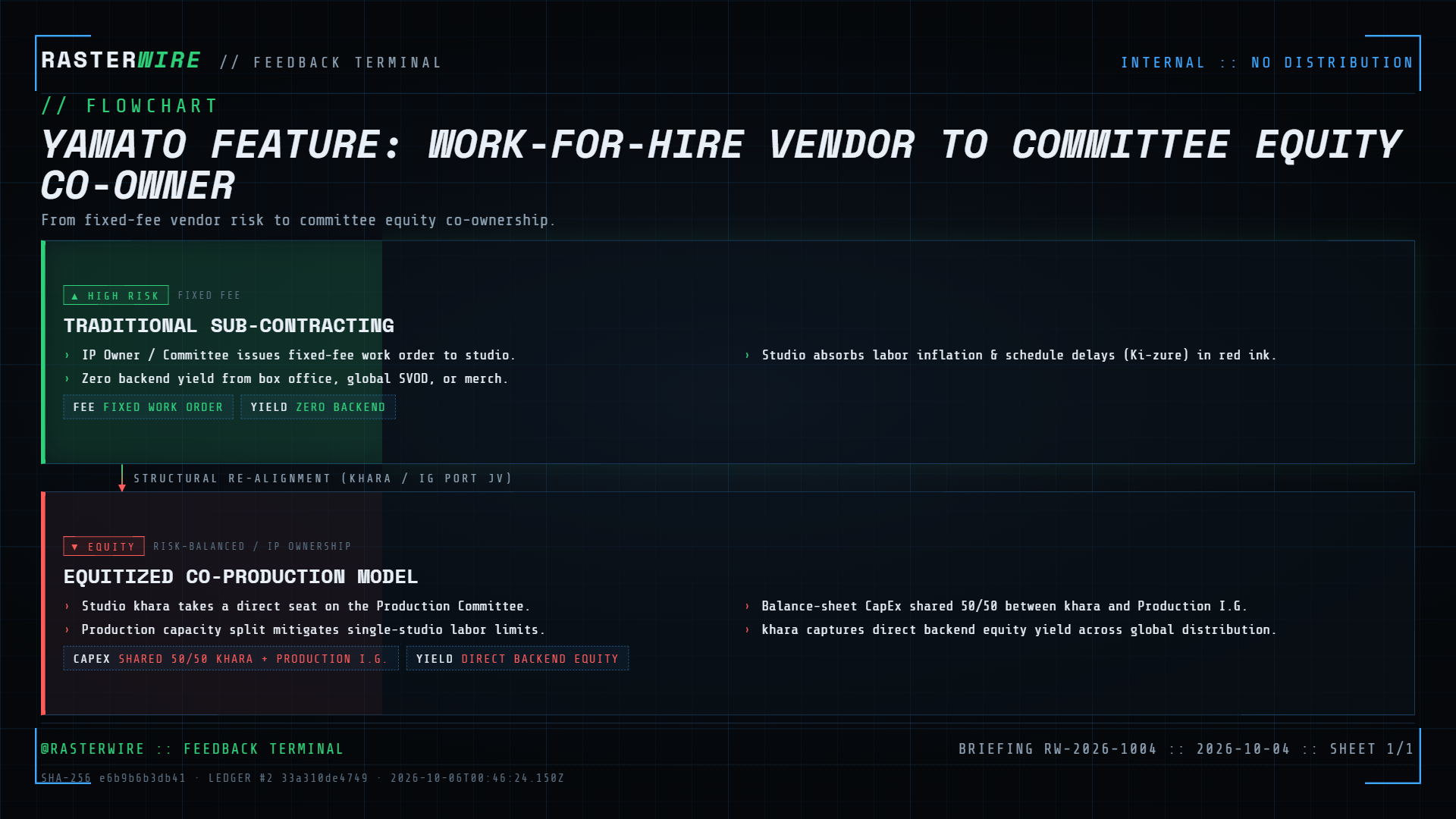
| // EQUITIZED CO-PRODUCTION FLOWCHART                                    |
| YAMATO FEATURE: WORK-FOR-HIRE VENDOR TO COMMITTEE EQUITY CO-OWNER       |
+-------------------------------------------------------------------------+
| TRADITIONAL SUB-CONTRACTING (High Risk / Fixed Fee)                     |
| - IP Owner / Committee issues fixed-fee work order to studio.           |
| - Studio absorbs labor inflation & schedule delays (Ki-zure) in red ink.|
| - Zero backend yield from box office, global SVOD, or merch.            |
+-------------------------------------------------------------------------+
                                     |
                 STRUCTURAL RE-ALIGNMENT (khara / IG PORT JV)
                                     v
+-------------------------------------------------------------------------+
| EQUITIZED CO-PRODUCTION MODEL (Risk-Balanced / IP Ownership)            |
| - Studio khara takes a direct seat on the Production Committee.         |
| - Balance-sheet CapEx shared 50/50 between khara and Production I.G.    |
| - Production capacity split mitigates single-studio labor limits.       |
| - khara captures direct backend equity yield across global distribution.|
+-------------------------------------------------------------------------+
EXECUTIVE SUMMARY: THE EQUITY CAPITAL PIVOT
The confirmation that Studio khara is co-producing the newly announced Space Battleship Yamato feature film alongside Production I.G—and crucially, taking a direct seat on the Production Committee (Seisaku Iinkai) to absorb investment risk—is being reported by consumer outlets as a fan-service milestone for Hideaki Anno. For capital desks, studio executives, and rights attorneys, this announcement reveals a far more significant corporate restructuring.
Studio khara is not acting as an outsourced service vendor or creative consultant. By deploying balance-sheet equity into the production committee of a third-party legacy franchise, khara is executing an asset-light IP stewardship strategy. Concurrently, IG Port (parent of Production I.G) is de-risking its own production pipeline by splitting capital expenditure, labor overhead, and schedule volatility (Ki-zure) with a top-tier primary contractor.
1. THE STRATEGIC SIGNAL: WORK-FOR-HIRE VS. COMMITTEE EQUITY
In the Japanese animation supply chain, the divide between a work-for-hire studio (Senmon Studio) and an equity-holding Primary Contractor (Motouke) dictates long-term solvency.
┌─────────────────────────────────────────────────────────────────────────┐
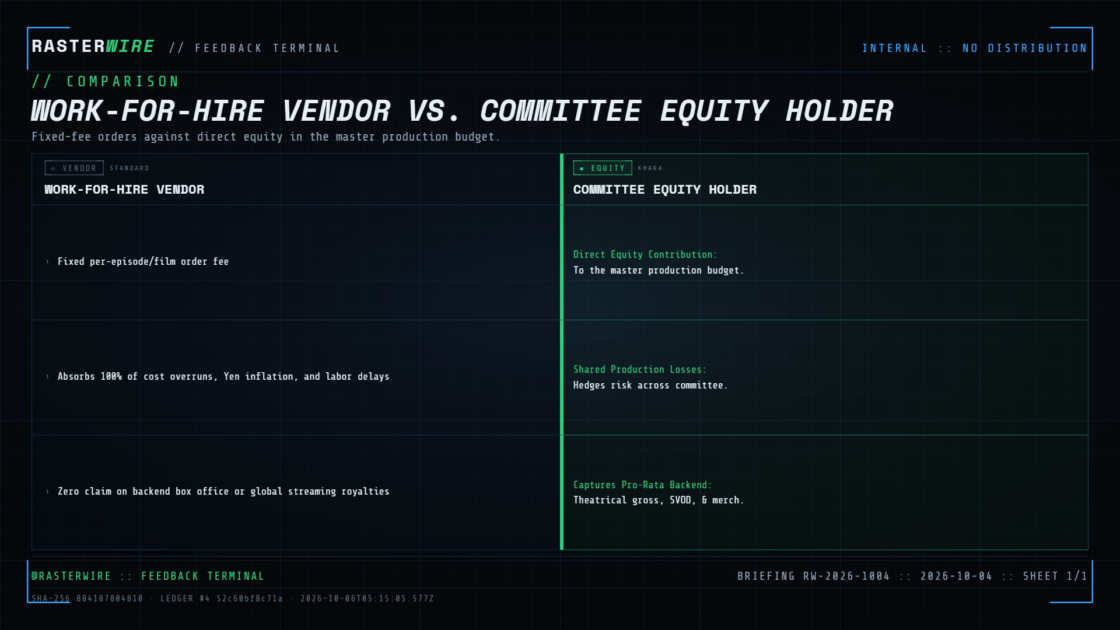
│             WORK-FOR-HIRE VENDOR VS. COMMITTEE EQUITY HOLDER            │
├───────────────────────────────────┬─────────────────────────────────────┤
│ WORK-FOR-HIRE VENDOR (Standard)   │ COMMITTEE EQUITY HOLDER (khara)     │
├───────────────────────────────────┼─────────────────────────────────────┤
│ • Fixed per-episode/film order fee│ • Direct equity contribution to the │
│                                   │   master production budget.         │
├───────────────────────────────────┼─────────────────────────────────────┤
│ • Absorbs 100% of cost overruns,  │ • Shares production losses, but     │
│   Yen inflation, and labor delays │   hedges risk across committee.     │
├───────────────────────────────────┼─────────────────────────────────────┤
│ • Zero claim on backend box office│ • **Captures Pro-Rata Backend:**    │
│   or global streaming royalties   │   Theatrical gross, SVOD, & merch.  │
└───────────────────────────────────┴─────────────────────────────────────┘
A. Escaping the Work-for-Hire Margin Squeeze
As detailed in Teikoku Databank’s primary survey data, 41.3% of specialized anime subcontractors operate in red ink due to rising in-house staff salaries and un-hedged production delays. By taking a formal committee seat, khara ensures that its operational expenditures are backed by direct backend equity participation. Rather than accepting a thin, fixed production fee that gets eroded by inflation, khara participates directly in top-line theatrical box office, global SVOD licensing, and secondary merchandising revenues.
B. The Post-Evangelion Capital Re-Allocation
Following the conclusion of Evangelion: 3.0+1.0 Thrice Upon a Time in 2021, khara faced a classic independent studio dilemma: how to maintain a highly paid, world-class in-house animation and 3D CGI team without burning capital on un-monetized internal R&D. Instead of launching un-tested, high-risk original IP from scratch, khara is deploying its capital reserves into established, high-probability Showa-era pillar franchises (Yamato). This replicates the capital-efficient model khara executed with the Shin universe (Shin Godzilla, Shin Ultraman, Shin Kamen Rider), where khara deployed talent and co-investment into established IP owned by Toho, Tsuburaya, and Toei while securing long-tail equity yield.
2. DE-RISKING IG PORT: MITIGATING STUDIO CAPACITY LIMITS (JUCHŪ SEIGEN)
For IG Port (Production I.G’s publicly traded parent company), bringing khara onto the committee as a co-investor and co-animator solves a critical operational bottleneck: physical capacity exhaustion.

┌─────────────────────────────────────────────────────────────────────────┐
│               IG PORT / PRODUCTION I.G CAPACITY MITIGATION              │
├───────────────────────────────────┬─────────────────────────────────────┤
│ CAPACITY FRICTION VECTOR          │ JOINT VENTURE RESOLUTION WITH KHARA │
├───────────────────────────────────┼─────────────────────────────────────┤
│ • Industry-wide animator shortage│ • Shared 2D/3D production pipeline  │
│   forces order refusals (*Juchū*) │   between I.G and khara studios.    │
├───────────────────────────────────┼─────────────────────────────────────┤
│ • High single-studio CapEx burn   │ • Committee equity split reduces IG │
│   on theatrical-grade feature CG  │   Port's direct balance-sheet risk. │
├───────────────────────────────────┼─────────────────────────────────────┤
│ • Schedule delay risk (*Ki-zure*) │ • Dual-studio capacity prevents     │
│   causing fiscal period loss      │   multi-year delivery slip page.    │
└───────────────────────────────────┴─────────────────────────────────────┘
Production I.G has managed modern Yamato remakes (2199, 2202, 2205, 3199) through various studio reorganizations (originally absorbing Xebec’s team). However, maintaining feature-quality sci-fi mecha and fleet animation requires immense, highly specialized 3D digital pipeline capacity.
By splitting both the production load and the financial equity with khara:
-
IG Port avoids over-leveraging its own balance sheet to fund the film’s master budget.
-
khara’s proprietary digital/3D unit handles heavy mechanical rendering and layout, freeing up Production I.G’s primary teams to maintain their other high-margin TV and film commitments.
-
The committee hedges against delivery delays (Ki-zure), ensuring the project stays on schedule without incurring massive overtime costs.
3. FINANCIAL & STRUCTURAL COMPARISON
| Operational Vector | Traditional Independent Studio Model | khara / Production I.G Co-Equity Model |
| Capital Source | 100% External Committee Financed | Co-Financed by Operating Studios (khara + I.G) |
| Backend Participation | Zero (Fixed work-for-hire contract) | Pro-Rata Equity Yield (Box Office, SVOD, Merch) |
| Capacity Allocation | Single studio bottleneck (Juchū Seigen) | Distributed dual-studio production pipeline |
| IP Governance | Controlled entirely by non-production committee | Studio directors sit directly on IP governance board |
| Balance Sheet Impact | High SG&A exposure; low margin ceiling | Risk-hedged CapEx; uncapped asset upside |
STRATEGIC IMPLICATIONS FOR CAPITAL DESKS
-
The Emergence of Studio-Led Co-Investment Consortia: Top-tier primary studios (Motouke) with strong balance sheets will increasingly demand equity committee seats when taking on high-budget feature remakes, refusing pure work-for-hire contracts on legacy IP.
-
Consolidation of Premium Sci-Fi CG Pipelines: Studio khara and Production I.G effectively establish a joint monopoly on high-end, theatrical-grade mechanical sci-fi production in Japan, combining khara’s 3D layout mastery with I.G’s established production infrastructure.
-
De-Risking the Showa IP Monetization Wave: Rights holders (Voyager Holdings, Bandai Namco) reduce their execution risk by granting equity to the creative stewards who hold the technical capacity to deliver feature-grade animation on time, aligning financial incentives between IP owners and production houses.
Continued on Page 2