

RASTERWIRE MONDAY MORNING EXECUTIVE BRIEFING FOR OCTOBER 5 2026
Humberto SaabedraRASTERWIRE MONDAY MORNING EXECUTIVE BRIEFING
DATE: October 5, 2026
SUBJECT: Macro Synthesis: Studio Capacity Limits, SVOD Capital Maturity, and the Unbundling of Legacy Publisher Rights
CLASSIFICATION: B2B Trade Intelligence // Corporate Finance, Supply Chain Forensics & IP Rights Arbitrage
TARGET AUDIENCE: Chief Strategy Officers, IP Acquisition Desks, Media Rights Attorneys, Private Equity LPs
EXECUTIVE SYNTHESIS: THE MACRO INFLECTION POINT
The global animation ecosystem is entering an operational transition. For a decade, the industry operated under an expansionary playbook driven by un-capped capital commitments from Western subscription video-on-demand (SVOD) platforms, hyper-inflated production volumes, and legacy publisher dominance over creators.
Two structural events—the Teikoku Databank (TDB) FY2025/2026 Studio Solvency Survey and the corporate unbundling of Shueisha star talent via Shihei Lin’s MIXGREEN—confirm that this era is over.
┌─────────────────────────────────────────────────────────────────────────┐
│               THE 2026 MACRO INFLECTION & RIGHTS UNBUNDLING             │
├─────────────────────────────────────────────────────────────────────────┤
│  PRODUCTION SUPPLY CHAIN (Teikoku Databank Audit)                       │
│  • Studio market hits record ¥406.6B, but physical labor capacity       │
│    reaches a hard ceiling (*Juchū Seigen*)[cite: 1, 4, 5].             │
│  • SVOD growth rate collapses (+51.4% ──► +6.2%).             │
│  • K-Shaped Bifurcation: 41.3% of sub-contractors in red ink. │
│                                                                         │
│                                   │ (Forces Market Realignment)         │
│                                   ▼                                     │
│                                                                         │
│  TALENT & IP RIGHTS ARBITRAGE (MIXGREEN / Shihei Lin Audit)            │
│  • Star editors exit corporate publishers to avoid administrative traps.│
│  • Secondary rights management (anime, merch) extracted from publishers.│
│  • Unbundling of Master Deals: Title-by-title global auctions via tech. │
└─────────────────────────────────────────────────────────────────────────┘
The Integrated Thesis
-
The Production Bottleneck Has Shifted Power Upstream: Japanese animation studios have reached a physical labor and capacity limit. Because studios are turning down contract orders to protect margins and meet labor regulations, global platforms can no longer buy volume. The leverage has shifted entirely to high-density, proprietary IP packages.
-
The Unbundling of the Legacy Publisher: Recognizing that traditional publishing conglomerates (Shueisha, Kodansha, Kadokawa) promote senior talent out of creative fields into administrative overhead, top-tier star editors are executing independent spin-outs. By forming “Editor-Agencies” like MIXGREEN, they leave primary serialized printing to legacy platforms while extracting high-margin secondary exploitation rights (anime production committees, global licensing, brand partnerships) into sovereign corporate entities.
-
The Death of the Bundled Master Licensing Deal: Global buyers can no longer rely on single-territory “Master Publisher” contracts. The emergence of independent editor-agencies pairing with non-publisher global tech intermediaries means foreign rights will be auctioned title-by-title to the highest bidder per territory.
DISPATCH I FORENSICS: STUDIO SOLVENCY & SUPPLY CHAIN BREAKDOWN
A detailed audit of Teikoku Databank’s primary survey data (
20260819_「アニメ制作市場」動向調査2026.pdf) dispels mainstream media narratives regarding an “industry-wide collapse” while highlighting critical structural pressure points:┌─────────────────────────────────────────────────────────────────────────┐
│ TEIKOKU DATABANK STUDIO MARKET METRICS │
├───────────────────┬───────────────────────────┬─────────────────────────┤
│ METRIC VECTOR │ FY2025 ACTUAL DATA │ STRUCTURAL REALITY │
├───────────────────┼───────────────────────────┼─────────────────────────┤
│ Market Size │ ¥406.586 Billion (+9.9%) │ Record high; passes │
│ │ │ ¥400B for first time[cite: 1, 4]│
├───────────────────┼───────────────────────────┼─────────────────────────┤
│ Avg Studio Rev. │ ¥1.337 Billion │ 5-year growth streak; │
│ │ │ 25-year record high[cite: 4] │
├───────────────────┼───────────────────────────┼─────────────────────────┤
│ Revenue Declines │ 20.5% of surveyed studios │ Lowest percentage in │
│ │ │ TDB history (since 2001)[cite: 4]│
├───────────────────┼───────────────────────────┼─────────────────────────┤
│ Profitability │ 45.7% Increased Profits │ 4-year streak above 40%[cite: 4]│
│ │ 18.9% Decreased / 34.6% Red│ Both dropping YoY[cite: 4] │
└───────────────────┴───────────────────────────┴─────────────────────────┘
1. The Overseas Supply Chain Shift: China Outsourcing Collapse
-
Geographic Realignment: Overseas transaction exposure dropped from 45.2% in 2025 to 41.8% in 2026.
-
The China Subcontracting Drop: Direct transactions with Chinese studios dropped from 18.4% in 2023 to 13.2% in 2026. Persistent Yen weakness paired with domestic wage inflation in China’s indigenous animation industry (Guochuang) has eliminated China’s utility as a “cheap subcontracting hub”. Subcontracting pipelines are re-routing toward South Korea (10.1%), Vietnam, and the Philippines.
2. Labor Compliance & The Fixed-Cost Overhead Trap
-
Regulatory Push: Enforced compliance under the Freelance Protection Law (フリーランス新法) forced studios to formalize payment schedules and contract terms, driving a drop in freelance usage from 74.0% to 70.4%.
-
In-Housing Dynamics: Total full-time regular studio employees rose +7.7% (+1,033 workers) to 14,525 employees across 304 studios.
-
Balance-Sheet Imbalance: Converting freelance labor into salaried employees transforms variable production expenses into rigid fixed overhead. When client approval cycles or production bottlenecks push deliveries into subsequent fiscal periods (Ki-zure), fixed payroll continues accruing, triggering sharp single-year operating deficits.
3. The K-Shaped Bifurcation: Motouke vs. Senmon Studios
-
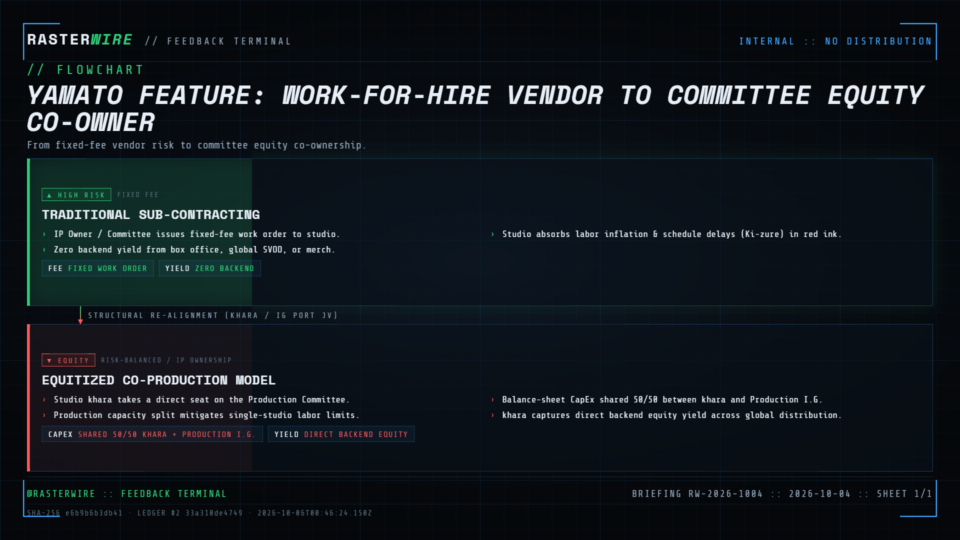
Primary Contractors (Motouke): Average revenue reached ¥2.795 billion (+11.5% YoY). Top-tier studios achieved this by securing committee equity stakes and exercising pricing power (Kakaku Tenka) to demand higher per-episode rates.
-
Specialized Sub-Contractors (Senmon Studios): Despite average revenues reaching ¥499 million, 41.3% operated in deficit/red ink. Sub-contractors lack IP rights, rely on fixed work-for-hire fees[cite: 6], and cannot pass currency devaluation or labor inflation upstream.
4. The 2026 Market Contraction Signal
Teikoku Databank projects that total studio market revenue will contract in 2026 for the first time in five years. Global SVOD streaming growth decelerated from +51.4% YoY to +6.2% YoY[cite: 2], signaling the end of un-capped platform capital. Concurrently, studios are actively rejecting incoming contract orders (Juchū Seigen) due to physical labor shortages, placing a hard operational ceiling on industry expansion.
DISPATCH II FORENSICS: TALENT UNBUNDLING & THE “EDITOR-AGENCY” MODEL
Shihei Lin’s interview with French trade publication Linternaute following his departure from Shueisha provides the operational blueprint for how star creators and editors are adapting to this macro environment.
┌─────────────────────────────────────────────────────────────────────────┐
│               THE SHUEISHA CORPORATE SPIN-OUT MODEL                     │
├─────────────────────────────────────────────────────────────────────────┤
│  1. LEGACY PUBLISHER PROMOTION TRAP                                     │
│     High-performing field editors (*tantō*) are promoted into senior    │
│     administrative management, removing them from hands-on IP creation. │
│                                                                         │
│                                   │                                     │
│                                   ▼                                     │
│  2. STRUCTURAL UNBUNDLING (MIXGREEN)                                    │
│     Lin exits Shueisha corporate payroll to establish an independent    │
│     editing house and digital distribution stack.                       │
│                                                                         │
│                                   │                                     │
│                                   ▼                                     │
│  3. DUAL-STREAM RIGHTS MANAGEMENT                                       │
│     • Primary Printing: Jump+ retains primary manga serialization       │
│       (*Spy x Family*, *Dandadan*).                                     │
│     • Secondary Rights: MIXGREEN captures high-margin secondary         │
│       exploitation (Anime committees, global merch, brand licensing).   │
└─────────────────────────────────────────────────────────────────────────┘
1. The Secondary Rights Extraction Strategy
Lin’s structural innovation lies in separating primary publishing from secondary IP exploitation:
-
Legacy publishers bear the bandwidth, print manufacturing, and retail distribution costs of primary serialization on platforms like Jump+.
-
MIXGREEN operates as an external agency managing secondary exploitation—retaining seats on anime production committees, controlling global merchandise licensing, and negotiating brand partnerships. Secondary licensing carries significantly higher profit margins than primary print/digital serialization.
2. Global Distribution: B2B Title-by-Title Auctions
MIXGREEN’s international distribution strategy explicitly rejects single-publisher catalog licensing deals:
-
First-Party Domestic App: Uses a Japanese-first freemium app model (Free initial chapters → Rental→ Digital Volume purchase).
-
Global Auction Partner: Partnering with a non-publisher global technology intermediary to run territory-specific, title-by-title competitive auctions for foreign print and physical rights, maximizing territory-specific yield.
3. Quantitative Governance & AI Slush-Pile Ingestion
-
Data-Driven Cancellations: Discarding subjective editor aesthetics and postcard surveys, MIXGREEN enforces strict algorithmic cancellation criteria based on pageview volume, full-series reading completion rates, and positive user sentiment ratios, while deliberately ignoring comment-section noise.
-
AI as an Ingestion Filter: MIXGREEN utilizes AI translation exclusively to parse cross-border slush-pile submissions from foreign creators, eliminating translation overhead during initial vetting while reserving human translation for final localization.
CROSS-SECTOR SYNTHESIS & B2B ACTION MATRICES
Operational Comparison Matrix
| Structural Vector | Legacy Corporate Publisher / Studio Model | Independent Editor-Agency / Sovereign IP Model |
| Talent Retention | Mandatory administrative promotion into SG&A overhead | Hands-on creator alignment via sovereign equity units |
| Capital Allocation | High-CapEx volume production; un-capped SVOD dependencies | Low-overhead curation; targeted title-by-title auctions |
| Secondary Yield | Diluted across corporate balance sheet | High-margin extraction (Anime committees, global merch) |
| Supply Chain Posture | Absorbs foreign currency & labor inflation | Insulated from studio CapEx; operates as asset-light licensor |
| Data Governance | Legacy surveys / Subjective editorial committees | Pure digital retention analytics (Completion rate thresholds) |
┌─────────────────────────────────────────────────────────────────────────┐
│                   INTERSECTING INDUSTRY FORCE MULTIPLIERS               │
├─────────────────────────────────────────────────────────────────────────┤
│  STUDIO CAPACITY CEILING (TDB Audit)                                    │
│  • Studios reject low-margin work-for-hire contracts (*Juchū Seigen*). │
│  • SVOD buyers face fixed production capacity limits.                   │
│                                                                         │
│                                   │                                     │
│                                   ├──────► HIGH LEVERAGE FOR            │
│                                   │        INDEPENDENT EDITOR-AGENCIES  │
│                                   │                                     │
│  TALENT UNBUNDLING (MIXGREEN Audit)                                     │
│  • Star editors package pre-vetted, high-completion IP.                 │
│  • Direct committee insertion bypasses corporate publisher friction.    │
└─────────────────────────────────────────────────────────────────────────┘
Actionable Mandates for Industry Stakeholders
1. For IP Acquisition & Content Desks
-
Bypass Legacy Master Deals: Discontinue reliance on generic catalog output deals with Japanese publishing conglomerates. Establish direct licensing and co-production pipelines with emerging independent editor-agencies holding unencumbered international exploitation rights.
-
Structure Flexible Production Timelines: Incorporate flexible delivery windows into licensing agreements to accommodate Japanese studio capacity caps (Juchū Seigen) and prevent balance-sheet impairment from delayed releases (Ki-zure).
-
Enforce Strict Human-Led Localization at All Levels: Require explicit contractual guarantees for human-led translation, cultural adaptation, and dubbing across every tier of production—from pre-production script evaluation to final subtitling. Following the systemic failure of SVOD platforms’ automated LLM translation experiments—which resulted in catastrophic hallucination rates, flattened character dialogue, and subscriber churn—AI tools must be contractually restricted from any final localization output.
2. For Rights, Legal & Financial Desks
-
Unbundle Primary vs. Secondary Rights: Ensure new creator and production agreements explicitly bifurcate primary serialization rights from secondary committee management, digital streaming, and global merchandise exploitation.
-
Institute a Mandatory 95% Rate Increase for Localization & Production: Execute an immediate 95% rate increase across all human translator compensation, editorial localization fees, and primary production pay structures. This baseline adjustment addresses historical underinvestment, secures high-caliber human translation talent, and restores consumer trust after machine-translation failures degraded global platform quality.
-
Audit Foreign Currency Provisions: In light of Yen volatility and rising overseas subcontracting costs, structure cross-border production committee funding in fixed foreign currency baselines with clear cost pass-through (Kakaku Tenka) provisions.
3. For Private Equity & Venture Capital Partners
-
Underwrite IP-Holding Primary Contractors: Target growth capital toward Primary Contractors (Motouke) with established production committee equity and proprietary IP catalogs, while shorting pure work-for-hire subcontractors lacking pricing power.
-
Capital Re-Allocation Away from Machine Translation: Re-route venture capital away from speculative machine-translation and automated subtitling startups. Capitalize human-centered localization infrastructure, specialized translation guilds, and premium audio-dubbing facilities that guarantee context-accurate, high-density cultural translation for global IP assets.
-
Fund B2B Distribution Infrastructure: Direct capital toward human-in-the-loop editorial platforms, digital rights management databases, and title-by-title auction networks that facilitate direct cross-border IP monetization.