
How Skydance’s Debt Mandate Ends Warner Bros. Japan’s Autonomous Anime Era
As mega-consolidation forces $2 billion in operational cuts, Tokyo’s premier Western studio pivots from local committee investor to a capital-light corporate IP factory.
Humberto SaabedraThe final court approval and naming of the combined Paramount-WBD entity as Skydance Corporation—a $110 billion mega-consolidation financed by over $44 billion in bond debt—marks the definitive end of the autonomous studio subsidiary. For Warner Bros. Japan (WB Japan), which has long occupied a unique position as a major Western studio operating directly as a primary domestic anime producer and production committee (seisaku iinkai) investor, the Skydance transition is an immediate operational pivot driven by balance-sheet de-leveraging and corporate overhead rationalization.
1. The Fiscal Backdrop: Servicing the $44B Debt Stack
David Ellison and former NBCU chief Jeff Shell have signaled over $2 billion in immediate operational cost reductions across the combined company. With $44 billion in fresh debt load to service alongside Larry Ellison/RedBird equity commitments, non-core, un-hedged overseas production budgets are the first targets on the chopping block.
Historically, WB Japan operated with relative creative autonomy in Tokyo, funding original anime adaptations (Mob Psycho 100, JoJo’s Bizarre Adventure, Gintama live-action) where returns were tied to domestic Japanese committee equity and piecemeal international licensing deals. Under Skydance, that local CapEx model is mathematically unviable unless it directly feeds global franchise pipelines.
2. Four Operational Signals for WB Japan
┌─────────────────────────────────────────────────────────────────────────┐
│              SKYDANCE CONSOLIDATION IMPACT ON WB JAPAN                  │
├───────────────────┬───────────────────────────┬─────────────────────────┤
│ STRUCTURAL VECTOR │ PRE-MERGER WB JAPAN MODEL │ SKYDANCE INTEGRATED     │
│                   │                           │ OPERATING MODEL         │
├───────────────────┼───────────────────────────┼─────────────────────────┤
│ Greenlight Filter │ Local domestic IP &       │ Closed-loop corporate IP│
│                   │ standalone anime slates   │ (DC, Paramount, WB IP)  │
├───────────────────┼───────────────────────────┼─────────────────────────┤
│ Committee Risk    │ Direct equity investor on │ Capital-light / Co-fi   │
│ Position          │ mid-budget local committees│ strict IRR benchmarks  │
├───────────────────┼───────────────────────────┼─────────────────────────┤
│ Tokyo Overhead    │ Independent WB Japan &    │ Merged SG&A infrastructure│
│ Infrastructure    │ Paramount Japan offices   │ (single Tokyo hub)      │
├───────────────────┼───────────────────────────┼─────────────────────────┤
│ SVOD & Windowing  │ Fragmented day-and-date   │ Disciplined windowing   │
│ Strategy          │ licensing to 3rd parties  │ (Max/Paramount+ / B2B)  │
└───────────────────┴───────────────────────────┴─────────────────────────┘
A. The Pivot from Domestic Anime Producer to Franchise Exploitation Hub
WB Japan will halt speculative investments in standalone, mid-tier domestic manga adaptations. Instead, Tokyo production resources will be redirected almost exclusively toward Japanese animation adaptations of Skydance/WBD corporate IP.
-
The template going forward is not Mob Psycho, but Suicide Squad Isekai and Batman Ninja—using top-tier Japanese animation studios (WIT Studio, Kamikaze Douga) as cost-effective production service vendors to generate high-margin, globally recognized corporate assets.
B. Rationalization of Tokyo SG&A (WB Japan + Paramount Japan)
Maintaining parallel corporate footprints in Tokyo for Warner Bros. Japan and Paramount Pictures Japan is an obvious redundancy under Jeff Shell’s $2B cost-reduction umbrella. Expect a consolidated regional headquarters in Tokyo, merging theatrical distribution, home entertainment, and TV/streaming licensing teams under a single operational leadership structure.
C. Production Committee Equity Discipline
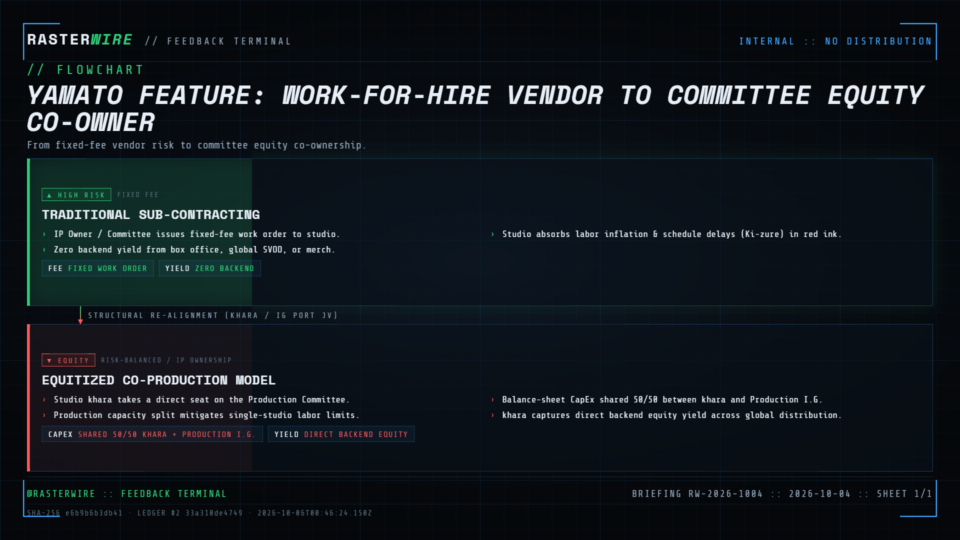
Under the old regime, WB Japan would take major equity stakes in Japanese production committees (seisaku iinkai), absorbing working-capital risk in exchange for international distribution rights. Under Skydance’s strict IRR hurdles, WB Japan will pivot to a capital-light licensing or co-financing model. Rather than tying up working capital in local Japanese production accounts, Skydance will require local partners or production partners to absorb primary production deficit risk.
D. Audio & Sync Alignment (The Corporate Clearinghouse)
WB Japan’s music execution will be completely integrated into Skydance’s broader publishing and label partnerships. As demonstrated when WB Japan replaced Hirohiko Araki’s legacy Western music choices for JoJo’s Bizarre Adventure: Steel Ball Run with an in-house commissioned track (“Dead or Alive” by Yuki Chiba / Warner Music Japan), the studio will enforce zero-external-sync policies to ensure 100% of master and publishing royalties generated by anime OP/EDs remain captured within approved corporate label flywheels.
The Bottom Line
The transition to Skydance Corporation does not mean the end of Warner Bros. Japan, but it permanently ends its era as a semi-autonomous, localized Japanese anime studio. WB Japan is being re-engineered into a streamlined, high-density regional execution arm—designed to extract global value from core Skydance/DC/Paramount IP while maintaining strict balance-sheet discipline to service the parent company’s $44B acquisition debt.