
The Googlebook Pivot: Android Stack Convergence, AI Agent Containers, and $899 Premium Hardware Standard
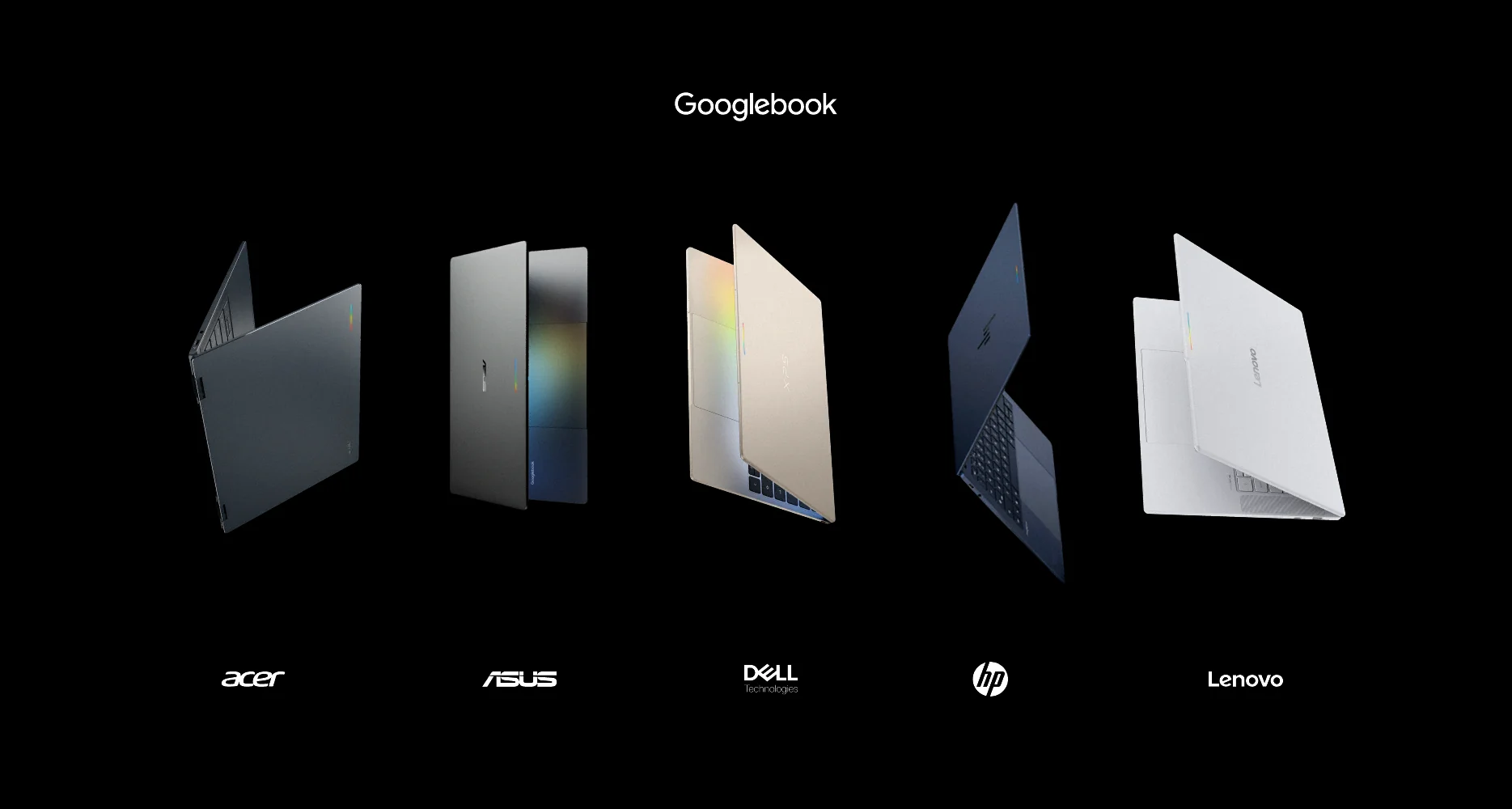
Humberto SaabedraMOUNTAIN VIEW, CA — Google has officially unveiled Googlebook, a new computing category merging Android’s system foundations with ChromeOS desktop capabilities. Positioned as direct ecosystem competition to Apple’s Continuity and Microsoft’s Copilot+ PC architecture, the platform sets an $899 entry tier for OEM partners (Acer, ASUS, Dell, HP, Lenovo) and marks Google’s full transition away from low-cost, budget-first Chromebook positioning.
Retail availability begins October 4, 2026 in the U.S. (October 5 internationally), backed by a mandatory 10-year feature drop and OS support lifespan.
- Primary Source:
[Google Official Blog / Product Announcement — 2026-09-21] - Key Mechanics:
$899 baseline price; >45 TOPS NPU baseline (Intel/Qualcomm); pKVM hypervisor Linux container; 10-year software update commit; release date 2026-10-04 - Supply-Chain & OS Signal:
Google abandons ChromeOS/Android dualism; forces PC OEMs into premium hardware margins while establishing an on-device environment for autonomous AI agents
Key Strategic Signals
- Total OS Convergence (Android Core + ChromeOS Shell)
Google is officially ending the decades-long fragment between ChromeOS and Android. Googlebook is architected on the Android system stack while retaining ChromeOS desktop windowing, mouse/keyboard input mechanics, and full Chrome browser extension support. Features like Continue On (app state handoff), Cast My Apps (real-time windowed Android streaming), and unified phone-to-laptop Files access directly mirror Apple’s macOS/iOS Continuity engine, targeting the high-margin Android flagship user base. - The $899 OEM Floor & Hardware Standard
By setting an $899 starting price floor, Google is enforcing premium bill-of-materials (aluminum, magnesium, 2.8K OLEDs, haptic glass trackpads) across initial partners Acer, ASUS, Dell, HP, and Lenovo. Mandating processors with >45 TOPS NPU accelerators (Intel and Qualcomm) brings hardware parity with Microsoft’s Copilot+ specification, ensuring local on-device LLM inference and long battery life (up to 14 hours). The return of the physical Glowbar serves as both a status indicator and a visual feedback loop for Gemini interactions. - Enterprise & Developer Agentic Sandbox (pKVM Hypervisor)
A subtle detail in the announcement is the inclusion of a Level 5 security-certified pKVM hypervisor powering an isolated Linux environment. Google is positioning Googlebook as a hardware platform for AI developers, bundling Antigravity (Google’s AI agent development framework) and supporting terminal environments like Claude Code. Isolating these agent execution layers within pKVM mitigates risk when running autonomous agents locally with full terminal rights. - Hardware-Integrated AI UI Mechanics
The platform introduces dedicated hardware-level interaction patterns: the Rambler Key (dedicated physical key replacing standard modifier keys for direct dictation-to-structured-text processing), Magic Pointer (cursor wiggle gesture that passes active window context directly to on-device Gemini models), and Create My Widget (natural-language prompt generation of custom desktop widgets). - Software Monetization & Lifecycle Guarantees
Every $899+ device includes 12 months of Google AI Pro (5TB cloud storage + Gemini Advanced access) alongside GeForce NOW and creative software bundles. A guaranteed 10-year update cycle stabilizes device resale values and enterprise procurement planning, directly addressing historic criticism of early Auto Update Expiration timelines.
Desk Note: The Googlebook Paradox — High-Margin Ambition Meets Historical Platform Churn
While the launch of Googlebook establishes an $899 hardware baseline and unifies Android and ChromeOS around local AI workloads, enterprise procurement desks and OEM partners face a familiar historical variable: Google’s pattern of splashy platform debuts followed by mid-cycle strategic pivots, hardware team dissolutions, and runtime deprecation.
The convergence onto the Android system stack and pKVM hypervisor represents Google’s fourth major platform re-architecture in a decade. For enterprise buyers and OEM hardware lines (Acer, ASUS, Dell, HP, Lenovo), evaluating the Googlebook platform requires weighting the promise of a 10-year update commitment against a historical track record of abandoned first-party halo hardware and shifting platform roadmaps.
- Primary Source:
[Overscan Strategic Analysis / Google Hardware Retrospective 2013–2026] - Disclosed Context:
$899 OEM floor; Android system stack migration; pKVM container isolation; 10-year feature lifecycle commit - Supply-Chain & Enterprise Risk:
High OEM margin commitments vs. risk of first-party hardware retreat and runtime deprecation cycles
┌────────────────────────────────────────────────────────────────────────┐
│             GOOGLE’S 13-YEAR DESKTOP & TABLET CHURN TIMELINE           │
├────────────────────────────────────────────────────────────────────────┤
│ 2013–2015: CHROMEBOOK PIXEL ($1,299)                                   │
│  └─ Premise: High-end halo hardware to force PC OEMs premium           │
│  └─ Outcome: Abruptly discontinued when OEMs defaulted to low-margin EDU│
│                                │                                       │
│ 2018–2019: PIXEL SLATE ($599–$999)                                     │
│  └─ Premise: Pivot to tablet/convertible form factor to challenge iPad │
│  └─ Outcome: Hardware line killed 8 months post-launch due to UI bugs  │
│                                │                                       │
│ 2022: PIXELBOOK LINE CANCELLATION                                      │
│  └─ Premise: Mid-tier Pixelbook Go & next-gen Tensor laptop roadmap   │
│  └─ Outcome: Project scrapped mid-development; hardware team dissolved │
│                                │                                       │
│ 2026: GOOGLEBOOK & ANDROID STACK RECONVERGENCE ($899+)                 │
│  └─ Premise: Merges Android core + ChromeOS shell + pKVM AI containers │
│  └─ Risk: Enterprise commitment reliant on multi-year org stability   │
└────────────────────────────────────────────────────────────────────────┘
- The “Halo Showcase” Abandonment Pattern
Google’s hardware strategy historically relies on expensive, showcase hardware to nudge OEM partners into new pricing tiers before quietly stepping back. The $1,299 Chromebook Pixel (2013), the ill-fated Pixel Slate (2018, cancelled eight months after launch), and the Pixelbook line (abruptly killed in September 2022 alongside the dissolution of its engineering team) illustrate a consistent pattern: Google uses first-party hardware to force an industry vector, then abandons the physical line when corporate priorities shift. - Architectural Runtime Fatigue
To bring Android applications to the desktop, Google has cycled through multiple incompatible runtime models: Native Client (NaCl), ARC (Android Runtime on Chrome), ARC++, ARCVM (virtualized containers), and now a unified Android system stack with a pKVM hypervisor. Each iteration forces enterprise IT managers and developers to re-certify software stacks, rewrite deployment scripts, or manage fragmented device fleets. While pKVM provides security isolation for local agent execution, it represents yet another fundamental platform migration. - Support Lifecycles vs. Management Re-org Velocity
Google’s guarantee of 10 years of software updates directly addresses historic backlash over Auto Update Expiration (AUE) dates that left functional hardware unsupported. However, software updates are only as durable as the internal organization backing them. Historically, internal re-organizations, re-allocated headcount, or shifting leadership within Google Devices & Services have led to sudden platform re-brandings and deprecations—leaving enterprise deployment roadmaps exposed to unexpected platform drift.